


Bitget Futures Referral Code FUTURESMAX: How to Trade Perpetual Contracts and Understand Fee Rebates

TL;DR
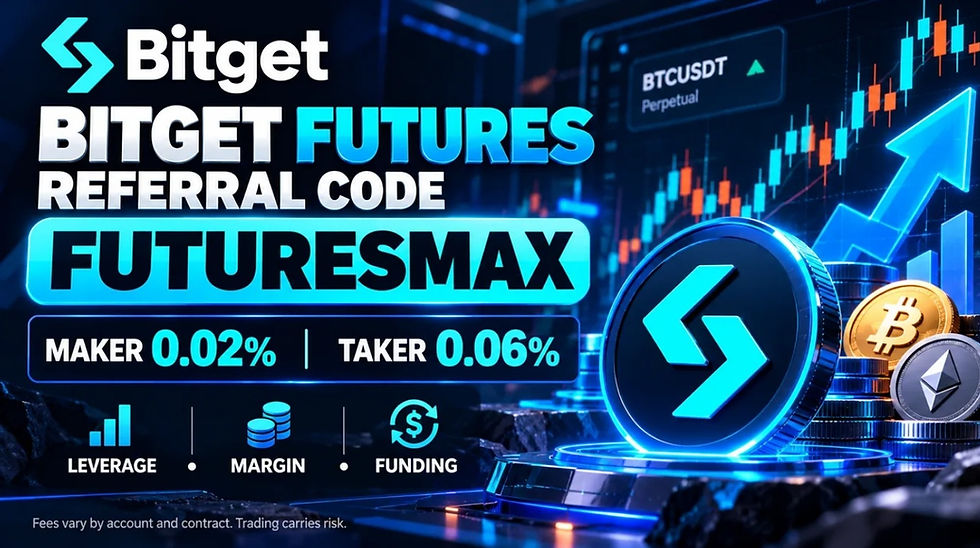
Bitget Futures allows eligible traders to access cryptocurrency derivatives, open long and short positions, and manage leveraged market exposure. Standard Futures trading fees generally start at 0.02% for maker executions and 0.06% for taker executions, although VIP status and contract conditions may change the actual rates. Bitget affiliate invitations can offer eligible users customized trading fee rebates, but the percentage depends on the specific referral arrangement. Futures trading also involves funding payments, margin requirements, liquidation risks, and the possibility of substantial financial losses. Before trading, users should review the actual referral benefits, secure their account, and understand how commissions are calculated using position notional value.
Bitget Futures referral code FUTURESMAX registration link:
Understanding Bitget Futures Before Opening an Account
Cryptocurrency exchanges offer different ways to participate in digital asset markets.
Spot trading involves purchasing or selling supported cryptocurrencies.
Futures trading is different because it provides market exposure through derivatives contracts rather than ordinary ownership of the underlying cryptocurrency.
Bitget Futures supports various cryptocurrency derivatives products for users who meet the platform's eligibility requirements.
Depending on the contract, traders can open positions that benefit from rising or falling prices.
These positions are commonly known as long and short positions.
Futures can also provide leverage, which allows a trader to control a position larger than the amount of initial margin deposited.
Although leverage can increase potential returns relative to collateral, it also magnifies losses.
Understanding the difference between position value and margin is essential before using these products.
Why Trading Fees Matter When Using Leverage
A common misunderstanding among beginners is that trading fees are calculated only on the funds initially deposited as margin.
In reality, Futures execution commissions are generally calculated using the executed position value.
Suppose a trader uses $200 in initial margin to open a $2,000 position.
Even though the initial margin is $200, the execution commission is normally calculated against the $2,000 notional exposure.
If the trader frequently opens and closes positions, these costs can accumulate.
A Futures trade may also involve separate fees when the position is closed.
Funding payments can introduce additional expenses when a perpetual contract remains open.
Therefore, understanding the entire cost structure is more useful than focusing exclusively on the advertised commission percentage.
Bitget Futures Referral Code FUTURESMAX: How the Invitation Works
The Bitget Futures referral code FUTURESMAX is an invitation identifier associated with an affiliate registration link.
Bitget allows eligible affiliates to create customized referral links and configure certain rebate settings for invited users.
According to the exchange's affiliate documentation, available settings can include separate arrangements for Spot, Futures, and other supported transactions.
However, the available rebate percentage depends on the affiliate account's permissions and product conditions.
This means that the commission earned by an affiliate is not automatically identical to the fee rebate received by the invited trader.
For example, Bitget publishes affiliate compensation arrangements of up to 50% of qualifying trading fees.
That percentage refers to potential affiliate earnings.
It should not be presented as a guaranteed 50% discount for every new user.
How to Verify the FUTURESMAX Invitation
Before registration, open the designated affiliate invitation.
Check whether FUTURESMAX appears in the registration details.
Review the actual rebate or promotional benefits associated with the invitation.
If the offer does not clearly display a percentage, users should not assume one.
Regional eligibility and the applicable exchange entity may also influence the benefits.
Official Bitget Futures Registration Link
Bitget Futures referral code FUTURESMAX:
The first address is the affiliate invitation supplied for this guide.
Users should verify that the expected invitation is displayed before completing registration.
An invitation code does not override regional restrictions or guarantee access to Futures products.
Bitget Futures Maker and Taker Fees Explained
Bitget uses maker and taker classifications to determine execution commissions.
A maker order provides liquidity by adding an order to the exchange order book without immediately executing against available orders.
A taker order removes liquidity by matching against existing orders.
Market orders generally act as taker orders.
Limit orders can act as either maker or taker orders depending on whether they execute immediately.
Standard Futures Fee Rates
For ordinary non-VIP Futures trading, Bitget publishes the following standard rates:
Fee Category | Standard Rate |
Maker fee | 0.02% |
Taker fee | 0.06% |
These percentages are starting reference rates.
Actual costs may differ according to account level, contract specifications, and applicable fee arrangements.
Example Futures Trading Fee Table
Executed Position Value | Maker Fee (0.02%) | Taker Fee (0.06%) |
$1,000 | $0.20 | $0.60 |
$2,500 | $0.50 | $1.50 |
$5,000 | $1.00 | $3.00 |
$10,000 | $2.00 | $6.00 |
$20,000 | $4.00 | $12.00 |
$50,000 | $10.00 | $30.00 |
These calculations represent individual executions.
If a trader both opens and closes a position, each execution can generate a separate commission.
Funding payments and additional product-specific expenses are not included.
How Futures Referral Fee Rebates Are Calculated
A referral rebate may return a qualifying portion of execution commissions to an eligible user.
Suppose a Futures transaction generates a commission of $6.
If the actual invitation provides a 10% rebate, the illustrative cashback would equal $0.60.
If a different qualifying invitation provides a 20% rebate, the illustrative cashback would equal $1.20.
These are examples, not confirmed FUTURESMAX rebate rates.
The actual amount depends on the invitation configuration and applicable program rules.
Why Net Trading Fees Matter
Bitget's affiliate policy explains that commissions can be calculated using net trading fees after applicable adjustments.
Certain transactions may not generate normal referral commissions.
Examples include zero-fee trades and transactions using particular rebate arrangements.
Therefore, a trader cannot assume every executed order automatically produces a referral cashback payment.
The appropriate approach is to check the referral terms and examine the account's actual fee records.
How to Register on Bitget Futures With FUTURESMAX
Step 1: Open the Affiliate Registration Page
Visit the official Bitget invitation link provided above.
Confirm that the website belongs to Bitget and that registration is available in your jurisdiction.
Step 2: Choose an Account Registration Method
Select an available method, such as email, mobile phone, or another supported sign-in option.
Use contact information that you control.
Step 3: Verify the Invitation Details
Check the registration interface for the FUTURESMAX invitation.
Review any displayed rebate, fee discount, or other account benefit.
Step 4: Complete Account Verification
Follow the account confirmation process.
Bitget may request identity verification depending on the account's jurisdiction and intended services.
Step 5: Enable Security Features
Create secure login credentials and activate supported two-factor authentication.
Review device and withdrawal protection settings.
Step 6: Open the Futures Trading Interface
After account verification, navigate to the Futures section.
Confirm that derivatives trading is available to your account.
Step 7: Review the Futures Agreement
Read the margin, leverage, liquidation, and funding disclosures.
Complete any applicable eligibility or knowledge requirements.
Step 8: Prepare the Futures Wallet
Review supported collateral and the available transfer options.
Do not transfer funds or open positions before understanding the potential risks.
USDT-M Futures and Coin-M Futures: What Is the Difference?
Bitget supports different derivatives categories in eligible markets.
USDT-M Futures generally use USDT as the relevant margin and settlement currency.
Coin-M Futures use supported cryptocurrencies as the margin and settlement assets.
These structures can create different financial exposures.
For example, when collateral is held in a cryptocurrency, changes in the value of that cryptocurrency may influence overall account risk.
Contract specifications determine settlement, funding, leverage limits, and margin requirements.
Users should review the exact contract rather than assuming every Futures product operates identically.
How to Transfer Funds Into Your Bitget Futures Account
Once an account is eligible for Futures trading, supported balances may be transferred into the relevant derivatives account.
Open the transfer interface and select the appropriate source and destination wallets.
Choose the supported asset and transfer amount.
Review the available balance and confirm the details.
Funds held in a Futures account may become collateral for leveraged positions.
Depending on the selected margin mode, losses can affect part or all of the collateral supporting those positions.
Money intended for essential expenses should not be allocated to speculative derivatives trading.
How to Open a Long Position on Bitget Futures
A long position generally benefits when a contract's price increases.
First, select an available Futures contract.
Review the current price, order book, funding conditions, and contract specifications.
Next, choose the margin mode and desired position size.
Examine the selected leverage and the resulting position notional value.
Before submitting an order, review estimated fees, margin requirements, and liquidation information.
If the market subsequently moves against the long position, the trader may experience losses.
Long positions do not guarantee profits simply because the broader market has previously risen.
How to Open a Short Position
A short position generally benefits when the contract price declines.
The trader selects a supported derivatives contract and chooses an appropriate sell or short order.
After entering the position size and reviewing margin settings, the order can be submitted if the account is eligible.
If the contract price rises unexpectedly, the position can lose value.
High leverage can make these losses especially severe.
A short Futures position is different from selling cryptocurrency already owned in a Spot wallet.
Understanding Leverage Through a Practical Example
Imagine a trader uses $300 in initial margin and selects 5x leverage.
The approximate position value becomes $1,500.
A favorable 2% price movement on a long position produces an unrealized gain of approximately $30 before fees and funding.
An unfavorable 2% move produces an unrealized loss of approximately $30.
Relative to the initial $300 margin, that is a 10% change.
The example illustrates how leverage magnifies exposure relative to deposited margin.
It does not calculate the exact liquidation price.
Liquidation depends on maintenance margin, position size, collateral, and additional contract conditions.
Cross Margin vs Isolated Margin on Bitget
Margin modes determine how collateral is allocated to open Futures positions.
Isolated Margin
With isolated margin, a specific collateral amount is assigned to an individual position.
This makes the initial margin allocation easier to identify.
However, the position can still be liquidated after adverse market movements.
Cross Margin
Cross margin allows eligible collateral to be shared between supported positions.
This can provide greater flexibility in margin allocation.
However, a losing position may consume collateral that would otherwise support other positions.
Users should understand the account-wide exposure before selecting cross margin.
Neither mode guarantees protection against substantial losses.
Funding Fees: A Cost Beyond Maker and Taker Commissions
Perpetual Futures commonly use funding payments to keep contract prices aligned with reference markets.
Depending on the funding rate and the direction of the position, a trader may pay or receive funding.
The funding rate can change over time.
Many perpetual contracts use periodic funding intervals, although the exact schedule depends on the instrument.
A position held across multiple funding settlements may therefore have additional costs.
Funding payments are separate from ordinary execution commissions.
A referral rebate should not automatically be assumed to reimburse funding payments.
Bitget VIP Trading Fee Levels
Bitget operates a tiered fee structure for eligible accounts.
Different VIP levels can provide different maker and taker commission rates.
Eligibility may depend on trading activity, asset requirements, or other applicable platform criteria.
A trader at a higher qualifying VIP level may pay lower commissions than a standard account.
For this reason, the final effective trading cost depends on more than the advertised referral benefit.
A meaningful comparison should consider the account's actual fee tier and qualifying referral arrangement.
Does BGB Reduce Bitget Futures Trading Fees?
BGB is the ecosystem token associated with Bitget.
For eligible Spot transactions, Bitget publishes a 20% discount when qualifying commissions are paid with BGB.
However, that Spot-specific deduction should not automatically be applied to standard Futures fees.
Futures rates and any applicable token-related or VIP benefits must be checked separately.
Users should not advertise an additional 20% Futures BGB discount merely because the same benefit exists for eligible Spot transactions.
Can Bitget Futures Traders Use Copy Trading?
Bitget offers copy trading services in supported markets.
These features may allow eligible users to follow trading strategies from selected traders.
However, copy trading does not guarantee that followers will obtain the same results as the trader being followed.
Execution prices, timing, position size, leverage, and funding costs can affect outcomes.
Some copy trading arrangements may also involve additional charges or profit-sharing provisions.
Users should understand those conditions before participating.
Copy trading can result in substantial losses.
Liquidation Risk and Position Management
Liquidation occurs when a leveraged position no longer satisfies the required margin conditions.
A sharp adverse market movement may quickly reduce available collateral.
Higher leverage generally increases sensitivity to market movements.
Stop-loss orders can help manage certain risks but do not guarantee execution at a specific price during extreme volatility.
Before trading, users should understand position size, liquidation thresholds, funding exposure, and the effects of their chosen margin mode.
Commission rebates do not protect positions against liquidation.
Account Security for Bitget Futures Traders
Use a unique password and activate available two-factor authentication.
Review unfamiliar devices and login activity.
Avoid suspicious trading applications or unknown bots requesting account permissions.
Never share recovery information or authentication codes.
Verify the authenticity of every registration and withdrawal page.
For cryptocurrency transfers, inspect the destination address and blockchain network carefully.
Account security and trading risk management should be treated as separate responsibilities.
Frequently Asked Questions
What is Bitget Futures referral code FUTURESMAX?
FUTURESMAX is an affiliate invitation code that eligible users can check during Bitget account registration.
Does FUTURESMAX provide a guaranteed Futures fee discount?
The exact rebate depends on the invitation settings and account eligibility. Users should verify the benefit displayed during registration.
What are the standard Bitget Futures maker and taker fees?
The published standard rates are generally 0.02% for maker executions and 0.06% for taker executions, before applicable adjustments.
Can a Bitget Futures referral provide commission cashback?
Eligible affiliate invitations can include user rebate settings. The applicable percentage depends on the specific invitation.
Does BGB automatically provide an extra 20% Futures fee discount?
No. The commonly advertised 20% BGB payment discount applies to eligible Spot trading fees and should not automatically be assumed to cover Futures.
Can I use my existing Bitget account for Futures?
Eligible users can generally access supported Futures services through their existing Bitget accounts, subject to verification and regional restrictions.
What is the difference between Cross Margin and Isolated Margin?
Isolated margin allocates collateral to a particular position, while cross margin can share eligible collateral across positions.
Can Bitget Futures positions be liquidated?
Yes. Adverse price movements can cause significant losses and forced liquidation when margin requirements are not satisfied.
Editor's Note
This guide focuses on Bitget Futures account registration, the mechanics of referral commission rebates, and the financial differences between Spot trading and leveraged derivatives.
The affiliate commission earned by the inviter must not be confused with the rebate available to the invited user.
Affiliate Disclosure and DYOR Disclaimer
Affiliate Disclosure: This article contains affiliate referral information. The publisher may receive compensation when eligible users register or complete qualifying trading activity.
DYOR — Do Your Own Research: Cryptocurrency Futures involve substantial financial risks. Leverage can amplify losses, while funding payments and liquidation may create additional expenses.
A trading fee rebate does not guarantee profitability or prevent capital loss.
This material is intended solely for general educational information and does not constitute financial, investment, legal, or tax advice.
Before trading, verify current fee schedules, invitation benefits, product availability, account eligibility, and local restrictions through official Bitget resources.
Last updated: October 27, 2026.


Comments